
Description
Power tools pallet — what this lot is
Power tools pallet is a single-pallet trade lot of power tools, hand tools, garden power equipment and DIY consumables, supplied at wholesale pricing to UK resellers rather than consumers. This page explains what is in the lot, how condition is graded, who tends to buy it, what the margin maths looks like, what freight involves, and the checks worth making before you pay. If you need the short version: the lot is £1,400 plus delivery, payment is by bank transfer, and lot detail is confirmed in writing for your specific pallet.
Every power tools pallet is sold as a complete unit rather than as individual items, and that is the point. Buying power and hand tools by the pallet lowers the cost per unit well below what you would pay piece by piece, at the cost of accepting an assortment you did not choose. That trade is the whole reason a power tools pallet exists as a product, and it is worth being clear-eyed about it before you order.
What this page covers
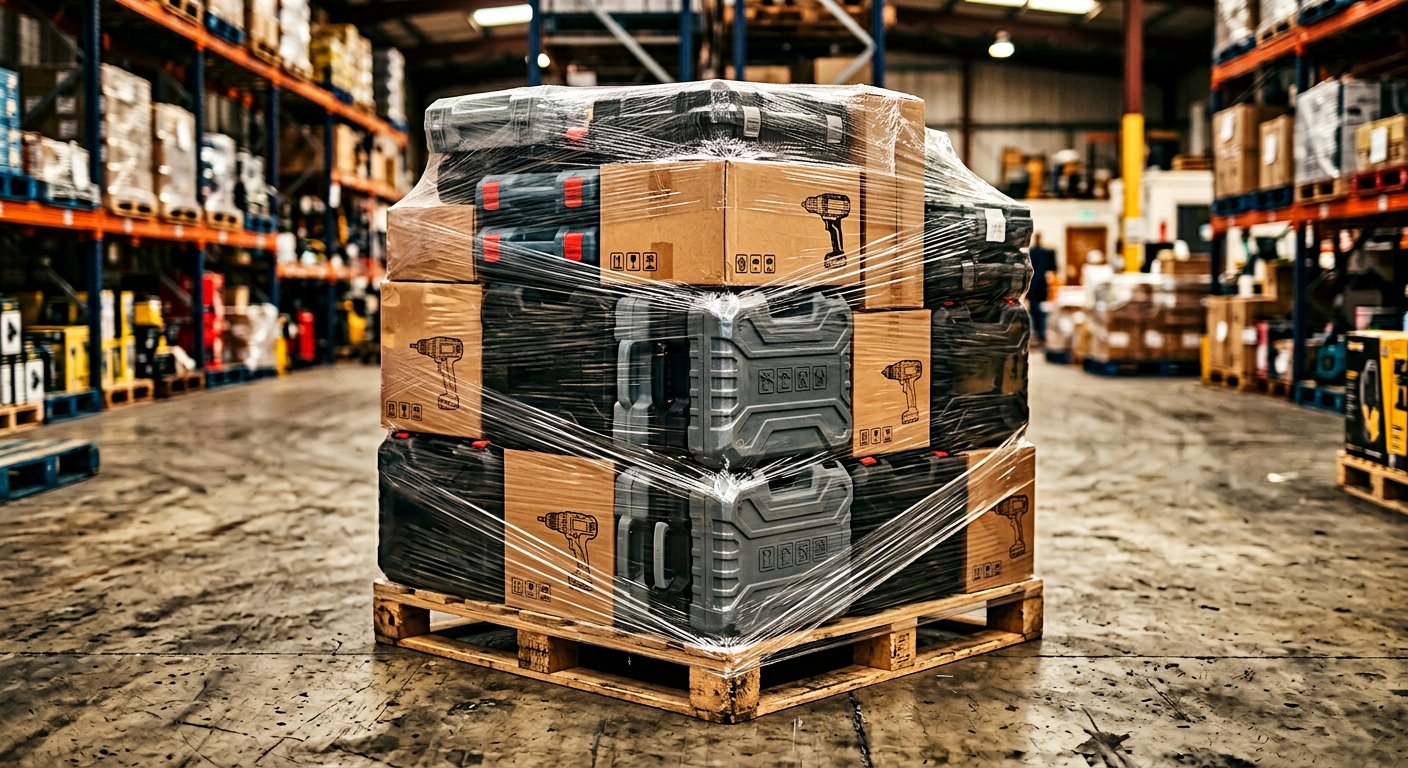
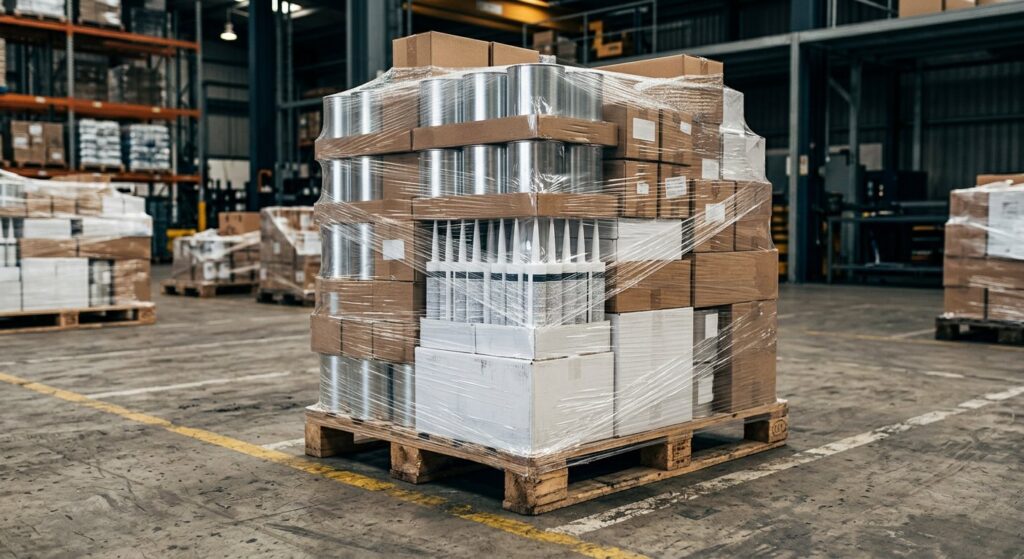
Representative lot image — an AI-generated illustration, not a photograph of the exact pallet. The current load photograph and manifest are confirmed in writing before ordering.
Inside a power tools pallet
Tools hold resale value unusually well because the buyer is often a tradesperson replacing a specific item, not a consumer browsing a catalogue. That makes the demand narrower but more price-resilient.
Battery platforms dominate modern power tools. A bare unit without a battery or charger is worth much less, and cross-compatibility between brands is limited, so a mixed-brand pallet splits into several smaller audiences.
Garden power equipment adds seasonal demand and fuel or battery handling. Petrol units in particular need care around storage and transport.
The load is described by category mix, condition band and — where available — manifest level. For a power tools pallet, the practical questions are how many units you should expect, what proportion is sellable, and whether the assortment skews toward one sub-category. Those three answers do more to determine your return than the headline price does.
Brands commonly seen in this category include established power tool and hand tool brands plus mid-market DIY labels. Brand mix matters because it drives both the speed of sale and the price you can hold, but it is rarely something a seller can guarantee precisely. Ask what proportion is branded versus generic.
Condition grades for a power tools pallet
Condition is where most disagreements start, so it is worth being precise about the vocabulary. New overstock is unsold stock, usually with tags or seals intact, that never reached a customer. Shelf pull has been handled on a shop floor. Customer returns have been bought and sent back, so expect everything from unworn to faulty. Salvage is the tail end and should be priced accordingly.
Ask whether batteries and chargers are included, and whether any unit has been tested under load rather than just switched on.
A single blended percentage across a whole power tools pallet is a marketing number. What is useful is a statement of how many units were inspected and how the inspection was sampled. If a seller cannot tell you how the sample was taken, treat the grade as an estimate rather than a specification.
Who buys a power tools pallet
This lot is bought mainly by three groups, and it suits each of them differently.
Tool resellers — who understand platform compatibility and price accordingly.
Tradespeople — who buy to use rather than resell.
Pawn and second-hand traders — who need recognisable brands with fast turnover.
What separates a good outcome from a poor one is rarely the pallet itself. It is whether the buyer already has a channel that can absorb the assortment at a sensible price, and somewhere dry to hold whatever does not sell in the first few weeks.
Working out the margin on a power tools pallet
Tools reward knowledge. A buyer who knows which battery platform is in demand locally can out-earn a generalist on identical stock.
At £1,400 for the lot, add delivery and your own handling time before you look at anything else. That landed cost divided by realistic sellable units gives you the number that actually matters. If the resulting cost per sellable unit is more than roughly a third of the price you can reliably achieve, the lot is not a bargain at any headline discount.
Model three things before committing: how many units you can list or display per day, how much dry storage you have for the unsold balance of the power tools pallet, and what happens to stock that has not moved after eight weeks. A power tools pallet that clears in six weeks is a business. One that takes six months is a storage cost with a pallet attached.
Freight, storage and handling a power tools pallet
Heavy and dense. Check floor loading and pallet weight before booking equipment.
Standard palletised freight is the normal route. That means a tail-lift vehicle unless you have a loading bay or a forklift, and it means the driver needs reasonable access — a dropped kerb, a flat approach and somewhere to turn around. Narrow service roads, residential postcodes, weight restrictions and low canopies all stop a delivery, and a failed drop costs more than a careful booking.
Confirm pallet weight and height before the delivery date. Weight determines what equipment is needed at both ends, and height determines whether the vehicle can carry it alongside anything else. For a power tools pallet, it is also worth asking whether the pallet is shrink-wrapped and corner-boarded, because a pallet that has been re-wrapped badly arrives with damaged corners and crushed cartons.
UK delivery coverage for a power tools pallet
Freight is quoted against your delivery postcode rather than a flat national rate, so it is worth knowing which part of the country you are in before you ask for a figure. Coverage runs across England, Scotland, Wales and Northern Ireland, and in practice the route to your door determines both cost and lead time.
Northern Ireland — Belfast, Lisburn, Newry, Derry/Londonderry, Bangor, Craigavon, Ballymena, Omagh, Enniskillen.
London and the South East — London, Croydon, Enfield, Barking, Romford, Watford, Slough, Reading, Oxford, Milton Keynes, Luton, Guildford, Brighton, Southampton, Portsmouth, Isle of Wight.
the West Midlands — Birmingham, Coventry, Wolverhampton, Walsall, Dudley, West Bromwich, Solihull, Sutton Coldfield, Stoke-on-Trent, Worcester, Hereford, Telford.
the North West — Manchester, Liverpool, Salford, Bolton, Wigan, Warrington, Stockport, Oldham, Rochdale, Preston, Blackpool, Lancaster, Carlisle.
Yorkshire and the Humber — Leeds, Sheffield, Bradford, Wakefield, Huddersfield, Halifax, York, Hull, Doncaster, Rotherham, Grimsby, Scunthorpe.
the North East — Newcastle upon Tyne, Sunderland, Gateshead, Durham, Middlesbrough, Stockton-on-Tees, Darlington, South Shields.
the East of England — Cambridge, Peterborough, Norwich, Ipswich, Colchester, Chelmsford, Stevenage, Basildon, Southend-on-Sea, King’s Lynn.
the South West — Bristol, Bath, Gloucester, Cheltenham, Swindon, Exeter, Plymouth, Truro, Taunton, Yeovil, Bournemouth, Poole, Salisbury.
the East Midlands — Nottingham, Leicester, Derby, Northampton, Lincoln, Chesterfield, Mansfield, Kettering, Corby.
Wales — Cardiff, Newport, Swansea, Bridgend, Barry, Cwmbran, Wrexham, Rhyl, Aberystwyth, Llanelli, Merthyr Tydfil.
Scotland — Glasgow, Edinburgh, Paisley, Livingston, Falkirk, Cumbernauld, Motherwell, Aberdeen, Dundee, Inverness, Perth, Stirling.
Counties covered include Greater London, Greater Manchester, Merseyside, West Midlands, West Yorkshire, South Yorkshire, Tyne and Wear, Kent, Surrey, Essex, Hertfordshire, Hampshire, Sussex, Berkshire, Buckinghamshire, Oxfordshire, Cambridgeshire, Norfolk, Suffolk, Lincolnshire, Derbyshire, Nottinghamshire, Leicestershire, Northamptonshire, Staffordshire, Shropshire, Worcestershire, Warwickshire, Cheshire, Lancashire, Cumbria, Durham, Northumberland, Gloucestershire, Somerset, Devon, Cornwall, Dorset, Wiltshire, North Yorkshire, East Riding of Yorkshire, and the county boroughs of Wales. If your address sits outside a city, that is not a problem; it simply changes the vehicle and the access plan rather than whether delivery happens at all.
Valuing this lot before you commit
Valuation is where most first-time buyers go wrong, and the error is almost always the same: they price the power tools pallet against the retail value of the brands inside it. Nobody achieves retail value on secondary stock. A more honest method is to look at what comparable items actually sold for in the last ninety days on the channel you intend to use, then discount for the proportion you expect not to sell at all.
Work the sum in this order. Count the units you can realistically list or display in week one. Multiply by a conservative average sale price. Subtract selling fees, postage or pitch fees, and the hours you will spend. Then compare that figure to the landed cost of the power tools pallet plus delivery. If the gap is thin at the conservative end, it will not survive contact with reality.
There is a second number worth calculating that most buyers skip: the cost of the tail. Every power tools pallet has a proportion of stock that will not sell in any reasonable timeframe. It still occupies floor space and it still cost money. Pricing the whole lot as though every unit will sell is the single most common reason a pallet that looked profitable on paper ends up breaking even.
Where this stock actually sells
The same lot performs very differently depending on channel, and the channel decision is worth making before you buy rather than after.
Marketplace selling — eBay, Amazon, Vinted and TikTok Shop — gives the widest audience and the highest average ticket, but charges fees and requires per-item photography and listing. It rewards patience and a routine. It is the right channel for anything with a brand and a recognisable model number.
Market stalls and car boot sales strip out fees and postage entirely and turn stock over in days rather than weeks. The trade-off is a much lower ticket price and a hard limit on how much volume a single pitch can absorb.
Bin stores and discount retail depend on volume and impulse. They suit mixed loads with a wide spread and punish anything that needs explaining or demonstrating.
Trade resale — selling the lot on in whole or in part to another business — is the fastest exit and the lowest margin. It is a sensible fallback if a lot turns out to be the wrong fit, and a poor primary plan.
The first 48 hours after delivery
What you do in the first two days determines how much of the power tools pallet you recover. The instinct is to start listing immediately; the better move is to inventory first, because a written record taken on day one is the only evidence you will have if something turns out to be wrong.
Photograph the pallet on the vehicle before it is broken down, then photograph each layer as you unpack it. Record pallet number, carton count, apparent condition band and anything obviously damaged. Note the date. If a dispute arises later, that record is what settles it — insurers and suppliers respond to contemporaneous evidence and ignore recollection.
Then sort by sellability rather than by category. The units you can list today should be separated from the units that need cleaning, testing or pairing, and both should be separated from anything you intend to bundle. Sorting by product category feels orderly but delays revenue, because the fastest sellers get buried under the slow ones.
Due diligence checklist
Before paying for any pallet lot, get answers in writing to the following. The list is short and it separates a professional supplier from a broker working from a photograph.
- whether batteries and chargers are included
- whether petrol units contain fuel
- the battery platform breakdown by brand
- the total pallet weight and dimensions
- what happens if the pallet is short or damaged on arrival
Anyone unwilling to put those answers in writing is telling you something useful. Our own position is deliberately blunt: lot detail, condition band and freight arrangements are confirmed in writing for your specific load before payment, and the images on this site are AI-generated illustrations rather than photographs of the actual pallet you will receive.
Related lots and buying formats
If this power tools pallet is close but not quite right, the tools and hardware range lists the alternatives in the same category. Buyers comparing formats also look at Garden & Outdoor Power Equipment Pallet, Home Improvement & DIY Stock Pallet, Hand Tools & Hardware Pallet. For a different scale entirely, truckloads and part-loads cover consolidated freight, and job lots and bundles offer a middle ground between one pallet and a trailer.
Before ordering, it is worth reading delivery information, payment information and returns and refunds. The pallet buying FAQ answers the questions that come up most often, and the buying guides go deeper on grading and resale channels.
Power tools pallet questions
Are batteries included with tool pallets?
Not always, and this changes the value substantially. A bare power tool without a compatible battery and charger sells for a fraction of a complete kit, so the battery position needs confirming before you buy.
Which tool brands hold value best?
Established professional-tier brands hold value far better than budget labels, largely because tradespeople are buying a known platform rather than shopping on price. Ask for the brand mix by pallet.
Should I test power tools before selling?
If you describe an item as working, it should work. Testing under load rather than simply switching on is the difference between an honest listing and a refund request.
What does a power tools pallet cost?
This lot is £1,400 before delivery. Freight depends on your postcode and access, so it is quoted separately against the delivery address rather than folded into a national rate.
How do I pay for a power tools pallet?
By bank transfer, after the lot has been confirmed in writing. Account details are sent with your order confirmation rather than published on the site, and a payment is not treated as received until our team verifies it. Once payment clears, a power tools pallet is reserved against your order and released to freight on the agreed dispatch date.
Five mistakes buyers make with a lot like this
Pricing against retail value. The retail value printed on a manifest is a reference point, not a forecast. Secondary market prices sit well below it, and a power tools pallet valued at RRP will always look better on paper than it performs.
Forgetting the tail. Every lot has a proportion of stock that will not sell at any sensible price. It still cost money and it still takes up space. Budget for it explicitly rather than discovering it in month three.
Underestimating the hours. Photographing, listing, packing and posting is labour. A load that takes two hundred hours to clear has a labour cost whether or not you account for it.
Ignoring freight access. A pallet that cannot be delivered to your address is not a bargain. Check the vehicle, the access and the equipment before the order, not on the morning of delivery.
Buying twice before checking once. Buy one pallet, work it through, measure what actually happened, and only then scale. The buyers who lose money in this trade almost always scaled before they had evidence. Treating a power tools pallet as a test rather than a windfall is the habit that separates buyers who are still trading a year later from those who are not.
Glossary of pallet-buying terms
The language of the secondary market is inconsistent between suppliers, which causes real confusion. These are the definitions used on this site.
Manifest — a list of what is on the pallet. It may be item-level (a row per unit), carton-level (a row per box with a quantity), or absent. Manifest quality is the single clearest indicator of how well a supplier knows their own stock.
Grade — a shorthand condition band, usually A to D or clear/returns/salvage. There is no industry standard, so a grade is only meaningful when the supplier defines it.
Shelf pull — stock removed from a retail shelf rather than returned by a customer. Usually complete, often handled, sometimes missing hangers or minor components.
Salvage — stock at the end of the recovery chain. Expect incomplete, damaged or faulty units and price accordingly. It is not a synonym for cheap returns.
Tail-lift — a hydraulic platform on the back of a delivery vehicle that lowers the pallet to ground level. Needed wherever there is no loading bay or forklift.
Pallet lot — a power tools pallet sold as one complete unit rather than as individual items, which is what makes wholesale pricing possible in the first place.
Landed cost — the purchase price plus delivery plus any handling, duty or storage cost before you sell a single unit. The only figure worth doing margin maths against.
Ordering
The short version: a power tools pallet is a single-pallet trade lot at wholesale pricing, sold complete rather than piecemeal, with condition and freight confirmed in writing before you pay.
To move ahead with this power tools pallet, send your delivery postcode and any access constraints through the contact form. You will get the current condition band, manifest position and a freight figure for your route. Nothing is charged until you confirm.
External reference: HSE work equipment guidance — www.hse.gov.uk.


Reviews
There are no reviews yet.